Start with the facts. Then add the truth.
Profit and loss matter, but they are not the full review. A winning session can hide bad decisions. A losing session can include strong play in a brutal game.
Record the basics
Venue, game, stakes, buy-in, cash-out, hours, and net result.
Tag the context
Table quality, fatigue, tilt, discipline, seat changes, and game selection.
Pick one lesson
If your review produces twelve vague fixes, it produced zero.
The five-question review.
Use the same review every time so emotion does not get to write the report.
Did I play the right game?
The best decision may have been leaving or table-changing.
What hand still bothers me?
That is usually where the study starts.
Was the mistake technical or mental?
Bad range work and bad emotional control need different fixes.
Close the loop before the next session.
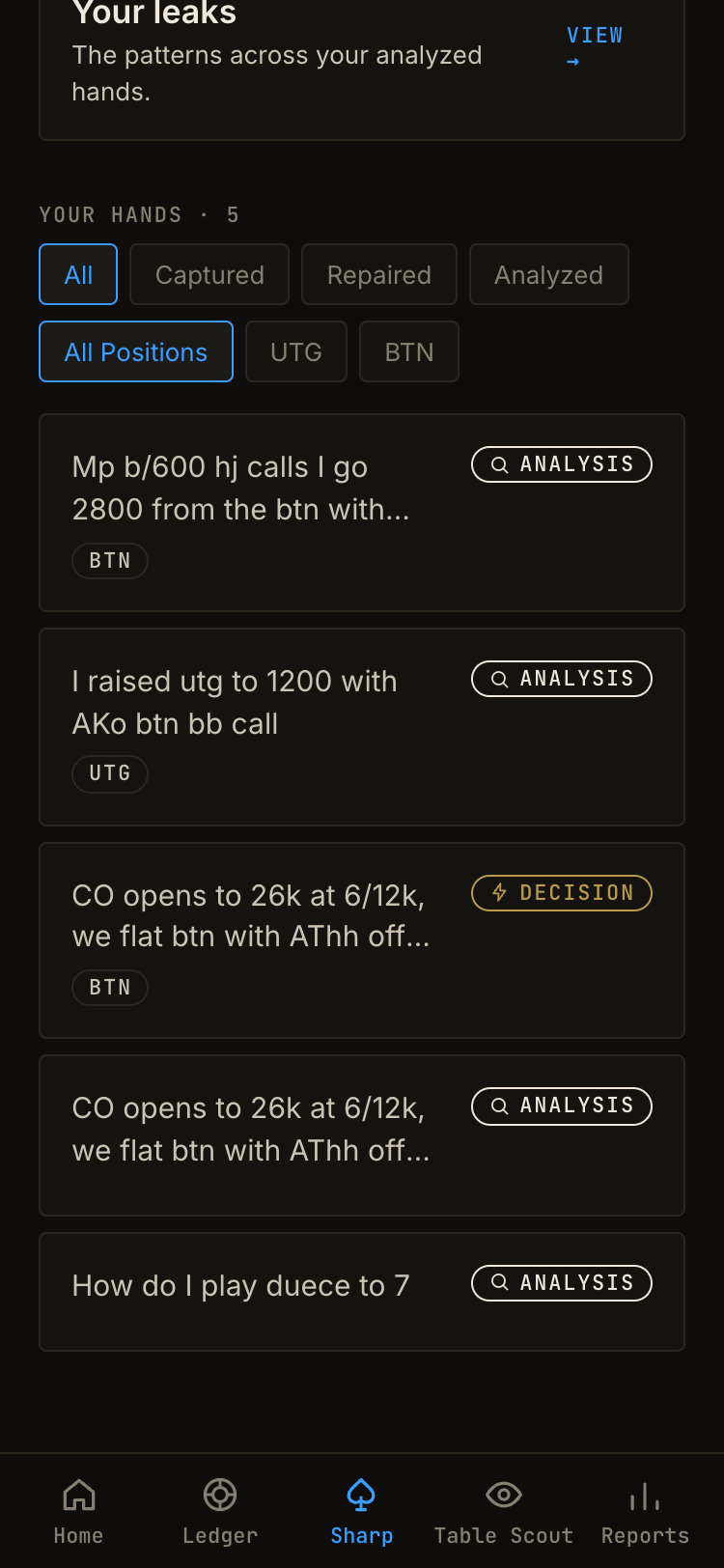
Send the important hand to Sharp, log the session in Ledger, and choose one adjustment. Not ten. One. Poker improvement compounds when the review habit survives contact with real life.
How to review a poker session without lying to yourself. FAQ.
How long should a poker session review take?
A useful review can take 10 to 20 minutes if you have good notes. Deeper hand review can take longer.
Should I review winning sessions?
Yes. Winning sessions can hide leaks, especially if one cooler or punt recovery carried the result.
What should I do with key hands?
Write the action, stack sizes, positions, board, bet sizes, reads, and the decision point. Then review the hand with a coach, study group, or Sharp.
What is the biggest session review mistake?
Only reviewing the final number. Profit and loss matter, but the decisions behind the number are what improve future results.
Keep building the edge.
These pages are wired together because the product is wired together: prepare, improve, measure.
Poker Session Tracker
Ledger: track real results
RELATEDWeekly Poker Performance Report
Turn sessions into a review loop
RELATEDAI Poker Coach
Sharp: review hands and leaks
RELATEDPoker Hand History Analyzer
Break down hands street by street
RELATEDPoker Player Lookup
Table Scout: research opponents
RELATEDBest Poker Tracking Apps
Compare tools for live players
One operating system for serious poker players.
Prepare with Table Scout. Improve with Sharp. Measure with Ledger. That is the loop.